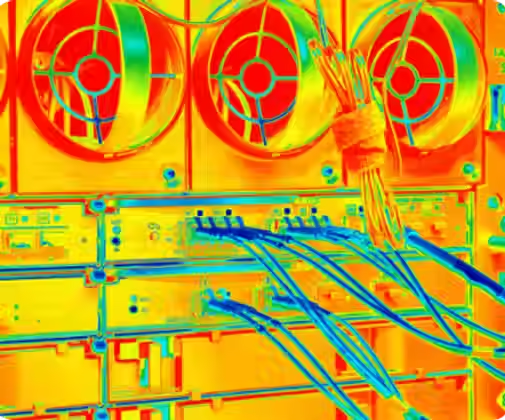
Manufacturing Plants: How Infrared Thermography Improves OEE (Overall Equipment Effectiveness)

In manufacturing, uptime is everything. Every minute of unexpected downtime impacts production targets, labor efficiency, on-time delivery, and profit margins. That’s why plant managers closely track Overall Equipment Effectiveness (OEE) — a key metric that measures how efficiently manufacturing assets are performing.
But here’s the challenge: many of the failures that reduce OEE begin as hidden electrical or mechanical issues long before a breakdown occurs. This is where infrared thermography in a manufacturing plant becomes a powerful performance tool — not just a safety inspection.
At Assured NDT, we help manufacturers use infrared (IR) inspections to detect hidden issues early, prevent equipment failure, and directly improve OEE across production lines.

Understanding OEE in Manufacturing
OEE measures three critical components:
Availability – Is equipment running when it should be?
Performance – Is it running at optimal speed?
Quality – Is it producing acceptable output?
Infrared thermography supports all three.
How Infrared Thermography Improves Availability
Unplanned downtime is one of the biggest contributors to reduced OEE.
Electrical failures are a leading cause of:
Motor shutdowns
Conveyor failures
Control panel malfunctions
Transformer outages
HVAC interruptions affecting production environments
How IR Helps:
Infrared inspections detect:
Loose electrical connections
Overloaded circuits
Failing breakers
Imbalanced phases
Overheating transformers
These issues can be corrected during scheduled maintenance instead of emergency shutdowns.
Result:
✔ Reduced unexpected downtime
✔ Improved equipment availability
✔ Higher OEE scores
How IR Improves Performance
Equipment that runs “hot” due to electrical or mechanical inefficiencies often performs below optimal levels.
Infrared manufacturing plant inspections identify:
Overheating motors
Bearing friction
Excess resistance in conductors
Cooling system inefficiencies
Phase imbalance reducing motor efficiency
Correcting these issues:
✔ Improves motor performance
✔ Reduces energy consumption
✔ Stabilizes operating speed
✔ Prevents performance degradation
Even small inefficiencies can compound over time and lower throughput.
How IR Supports Quality Output
Electrical instability and overheating components can cause:
Voltage fluctuations
Process interruptions
Inconsistent machine operation
Defects in automated production lines
By maintaining stable electrical systems through proactive infrared inspections, manufacturers protect:
✔ Product quality
✔ Precision processes
✔ Automated systems
✔ Continuous production standards
Reliable power equals reliable output.
Infrared Thermography and Predictive Maintenance
Modern manufacturing is shifting from reactive maintenance to predictive strategies.
Infrared thermography is a core diagnostic tool in predictive maintenance because it:
Detects problems before failure
Supports condition-based maintenance (CBM)
Aligns with NFPA 70B requirements
Reduces emergency repair costs
Improves asset life cycle management
Instead of reacting to breakdowns, IR allows plant managers to plan repairs strategically.
NFPA 70B and Manufacturing Compliance
The 2023 update to NFPA 70B now requires:
Annual infrared inspections of energized electrical equipment
Documented condition-based maintenance
Corrective action tracking
Manufacturing plants must comply not only for safety, but also to meet insurance and regulatory expectations.
Infrared inspections are no longer optional — they are part of responsible plant management.
The ROI of Infrared in Manufacturing
Consider the cost of:
One hour of downtime
Emergency labor rates
Production backlog
Missed customer deadlines
Equipment replacement
Now compare that to the cost of a scheduled infrared inspection.
Many manufacturers report:
✔ 5–10x return on inspection investment
✔ Reduced unplanned outages
✔ Improved MTBF (Mean Time Between Failures)
✔ Higher OEE percentages
Infrared thermography is one of the highest-return maintenance tools available.
What Equipment Should Be Included in an Infrared Manufacturing Plant Inspection?
A comprehensive inspection typically includes:
Main switchgear
Motor control centers (MCCs)
Distribution panels
Transformers
Motors and drives
VFD systems
Bus ducts
HVAC electrical systems
Generator and backup power systems
Assured NDT provides severity rankings and prioritized reporting to support maintenance planning.
Why Manufacturing Plants Choose Assured NDT
Assured NDT provides:
Certified thermographers
Experience in industrial environments
NFPA 70B-compliant inspection protocols
Flexible scheduling during shutdowns or off-shifts
Clear, actionable reports
Nationwide service coverage
We understand production pressures — and we inspect accordingly.
Improve OEE with Proactive Infrared Inspections
If your plant tracks OEE, uptime, and reliability metrics, infrared thermography should be part of your maintenance strategy.
Contact Assured NDT to schedule an infrared inspection for your manufacturing plant👉 https://www.assuredndt.com/contact
FAQs: Infrared Manufacturing Plant Inspections
1. How does infrared thermography improve OEE in manufacturing plants?
Infrared inspections improve OEE by reducing unplanned downtime, improving equipment performance, and stabilizing production quality.
2. What problems can infrared inspections detect in a manufacturing plant?
IR inspections detect overheating connections, overloaded circuits, failing motors, phase imbalance, and transformer issues before failure occurs.
3. Is infrared inspection required for manufacturing facilities?
Yes. NFPA 70B requires annual infrared inspections of energized electrical equipment as part of condition-based maintenance.
4. Can infrared inspections be performed without shutting down production?
Yes. Infrared thermography is non-contact and performed while equipment remains energized.
5. How often should manufacturing plants perform infrared inspections?
At minimum, annually. High-load or mission-critical facilities may inspect more frequently.