White Paper: What NFPA 70B Compliance Means for Infrared Thermography & Electrical Safety

Updated: 4 minutes ago
NFPA 70B, Standard for Electrical Equipment Maintenance, puts infrared thermography at the center of electrical maintenance. It lists infrared inspection for all electrical equipment at least every 12 months, and every 6 months for equipment in poor condition (NFPA). This page summarizes what the standard asks for, what a useful infrared report contains, and what changed in the 2026 edition. The full Assured NDT white paper is available as a free PDF below.
Key Takeaways
NFPA 70B became a standard, not a recommended practice, with the 2023 edition. The 2026 edition is now current (NFPA).
It uses mandatory "shall" language but is enforceable only when a jurisdiction, regulation, contract, or insurer requires it (Reliability Magazine).
Infrared thermography applies to all equipment: every 12 months in Condition 1 or 2, and every 6 months in Condition 3.
Scans are done with covers removed and equipment under load, and temperature differences (ΔT) must be documented.
The 2026 edition adds a required timeline for repairs and recognizes continuous thermal monitoring.
Download the full white paper (PDF):
Is NFPA 70B Mandatory?
NFPA 70B was a recommended practice until the 2023 edition turned it into a standard, and the 2026 edition replaced it as the current version (NFPA). As a standard, it is written in mandatory "shall" language. It becomes legally enforceable at a facility when a jurisdiction adopts it, a regulation incorporates it, or a contract or insurer requires it (Reliability Magazine).
In practice, pressure often comes first from insurers and clients, who ask what equipment has been identified, which assets are critical, and whether deficiencies are being corrected (NAES). Even where it is not adopted into code, NFPA 70B is widely treated as the benchmark for reasonable electrical maintenance after an incident or during an audit.
What NFPA 70B Says About Infrared Thermography
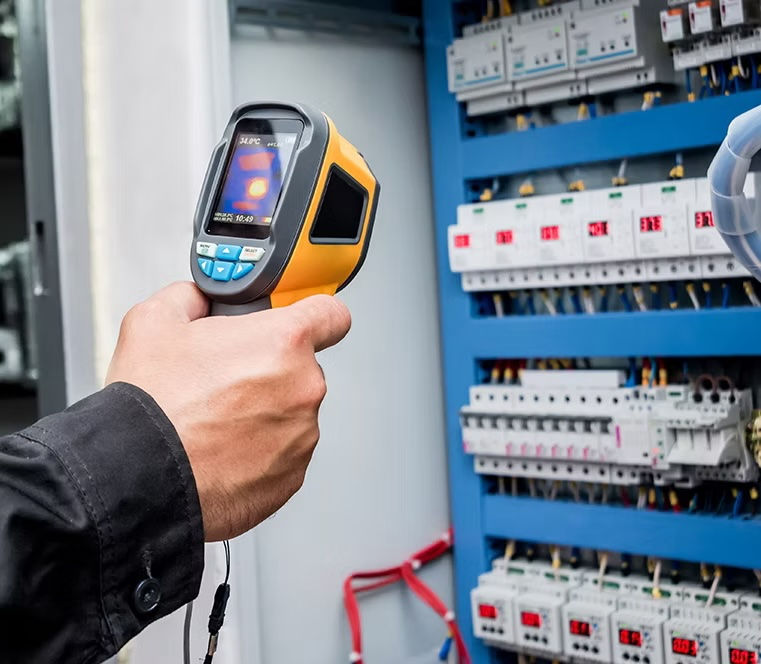
NFPA 70B treats infrared thermography as a core inspection method for electrical connections and terminations. Key requirements in the standard include (NFPA):
Connections and terminations are inspected with infrared thermography in accordance with Section 7.4.
Covers removed: all accessible and necessary covers are removed before the scan to give a clear line of sight to the equipment.
Under load: inspections are performed at normal circuit loading. Where that is not feasible, loading of at least 40 percent of nominal is permitted.
ΔT documented: temperature differences between the area of concern and the reference area are documented.
Earlier editions recommended annual infrared scans mainly for equipment such as switchgear, motor control centers, busway, and UPS systems. The 2023 standard extended infrared inspection to all electrical equipment (TÜV SÜD).
How Often: Equipment Condition Sets the Interval
NFPA 70B sets maximum maintenance intervals based on each asset's physical condition. For infrared thermography, the intervals are (HVM):
Condition 1 (like new): every 12 months. The enclosure is clean, dry, and tight, there are no open monitoring alerts or predictive recommendations, and past maintenance followed the program.
Condition 2: every 12 months. Results deviate from past results, the last cycle required repair or replacement of major components, or there are active recommendations from predictive techniques.
Condition 3: every 6 months. The equipment missed its last two maintenance cycles, the last two cycles required major repairs, there is an unaddressed monitoring alert, or predictive techniques flagged urgent action.
Condition 4: equipment that poses an imminent risk is designated nonserviceable and needs immediate action.
Once the interval is set, the standard expects it to be followed for at least two maintenance cycles unless unexpected failures or other changes justify revising it (NFPA). For a step-by-step approach, see how to build a condition-based maintenance program under NFPA 70B.
What a Compliant Infrared Report Should Include
The standard requires ΔT documentation. A report that will hold up with an insurer, auditor, or authority having jurisdiction typically also includes (IRINFO):
Date and time of the inspection
Name and qualification of the thermographer
Camera make and model, plus emissivity and reflected temperature settings
Ambient temperature, humidity, and circuit loading at the time of the scan
Location and identification of each piece of equipment
Thermal and visible images of each finding
ΔT values for each area of concern and its reference
Severity rating and recommended corrective action
Our guide on documenting thermography inspection findings explains how to structure findings so they feed directly into your maintenance program.
What Changed in the 2026 Edition
The 2026 edition keeps the condition-based framework from 2023. NFPA lists five headline changes: the P–F curve method for setting maximum intervals, a new requirement to establish a timeline for repairs and corrections, more detail in the inspection and testing tables, a new chapter on transfer switches, and improved consistency across chapters (NFPA).
Two changes matter most for infrared programs. A repair timeline means hot spots found during a scan now need a documented plan and date for correction. And permanently installed, continuously monitoring temperature devices may satisfy infrared thermography requirements for the equipment they cover (Eaton). Read the full breakdown in NFPA 70B 2026: what changed and what to update.
Why It Matters for Risk, Insurance, and Uptime
Safety: loose connections, overloaded circuits, and failing components often show up as heat long before they fail.
Uptime: infrared scans are performed on energized equipment, so problems can be found without a shutdown.
Insurance and audits: a documented infrared program answers the questions insurers and clients increasingly ask about electrical maintenance.
Local requirements: in South Florida, some recertification programs separately require infrared inspection of larger electrical systems. See our Boynton Beach and Boca Raton recertification guide.
For property owners, our commercial real estate electrical maintenance white paper covers how these programs support budgeting and asset value.
How Assured NDT Helps
Assured NDT's certified thermographers perform NFPA 70B infrared inspections on energized electrical equipment, assign condition ratings, and deliver reports with ΔT values, images, severity, and recommended actions. We also help teams build a full NFPA 70B electrical maintenance program. For South Florida facilities, see infrared thermography in West Palm Beach.
[Contact Assured NDT](https://www.assuredndt.com/contact) or call 561-660-2751 to schedule an NFPA 70B infrared inspection.
Frequently Asked Questions
Does NFPA 70B require infrared thermography?
Yes, within the standard. NFPA 70B lists infrared thermography for all electrical equipment in its maintenance interval table: at least every 12 months for equipment in Condition 1 or 2, and every 6 months for Condition 3 (NFPA). Whether that is legally required at your facility depends on whether a jurisdiction, regulation, contract, or insurer has adopted or required NFPA 70B (Reliability Magazine).
Is NFPA 70B the law?
Not automatically. NFPA 70B has been a standard with mandatory "shall" language since the 2023 edition, and the 2026 edition is now current. It becomes enforceable when a jurisdiction adopts it, a regulation incorporates it, or a contract or insurer requires it (Reliability Magazine).
How often does NFPA 70B call for infrared inspections?
At least every 12 months for equipment in Condition 1 or 2, and at least every 6 months for equipment in Condition 3, such as equipment that missed its last two maintenance cycles or has an urgent finding from predictive techniques (HVM).
What should an NFPA 70B infrared report include?
At a minimum, the temperature difference (ΔT) between each area of concern and a reference area must be documented (NFPA). Good reports also list the date, thermographer and qualification, camera, ambient and load conditions, equipment location, thermal and visible images, severity, and recommended action (IRINFO).
Can continuous thermal monitoring replace an annual infrared scan?
In some cases. Analyses of the 2026 edition note that permanently installed, continuously monitoring temperature devices may satisfy infrared thermography requirements for the equipment they cover (Eaton). Equipment without monitoring still needs periodic scans.
About the Author
Stephen Fike is the Principal of Assured NDT and Risk Assured, where he leads a team specializing in risk engineering, fire protection, and non-destructive testing for complex facilities across hospitality, healthcare, manufacturing, and real estate. He has more than a decade of experience at firms including PwC, Marsh, Willis Towers Watson, USI, and AIG, and has evaluated properties exceeding $1 billion in value. Stephen holds a degree in Civil and Environmental Engineering from Penn State University.