White Paper: Electrical Maintenance Programs for Commercial Real Estate

For commercial property managers and facility engineers, electrical maintenance is no longer simply a matter of keeping the lights on.
The condition and reliability of a building’s electrical infrastructure can affect tenant safety, business continuity, operating expenses, equipment life, insurance considerations, and ultimately the value of the property itself.
That makes a structured Electrical Maintenance Program (EMP) increasingly important for commercial real estate owners and operators.
Changes to NFPA 70B have also elevated the importance of electrical equipment maintenance. Rather than approaching maintenance as an informal best practice, commercial facilities should establish a documented program for inspecting, testing, servicing, and maintaining electrical equipment.
At Assured NDT, we help commercial real estate teams develop and execute Electrical Maintenance Programs designed around their facilities, equipment, operational requirements, and risk profiles.

Download the white paper linked above here.
What Is an Electrical Maintenance Program?
An Electrical Maintenance Program, or EMP, is a structured process for inspecting, testing, servicing, and documenting the condition of a facility’s electrical systems.
Instead of waiting for equipment to malfunction, an EMP creates a proactive framework for identifying signs of deterioration and addressing potential problems before they develop into larger failures.
For commercial buildings, this can include equipment and systems such as:
Main distribution equipment and switchgear
High- and medium-voltage equipment
Switchboards and circuit breakers
Transformers
Emergency generators and automatic transfer switches
Grounding systems
Arc flash labels and electrical documentation
The objective is not simply to complete maintenance tasks. A well-designed EMP connects electrical safety and compliance with equipment reliability and long-term facility performance.
Why NFPA 70B Matters for Commercial Buildings
NFPA 70B, Standard for Electrical Equipment Maintenance, provides a framework for maintaining electrical equipment and establishing an Electrical Maintenance Program.
This is especially important for commercial real estate, where electrical infrastructure may operate for decades while supporting increasingly demanding building systems and tenant loads.
A formal electrical maintenance program can help commercial property teams:
Protect people and property. Electrical deterioration, overheating, loose connections, and other problems can create serious safety and fire risks.
Reduce unexpected equipment failures. Regular inspection and testing can reveal developing problems before equipment reaches the point of failure.
Extend equipment service life. Maintaining equipment under appropriate operating conditions can help maximize its useful life.
Reduce business interruptions. An unexpected electrical failure can affect tenants, building operations, critical systems, and revenue-generating activities.
Support compliance efforts. A documented program creates a structured maintenance record that can support conversations with authorities having jurisdiction, insurers, and other stakeholders.
For property teams overseeing multiple buildings, an EMP can also establish consistency across a portfolio rather than relying on reactive maintenance at individual properties.
The Hidden Electrical Risks Inside Commercial Real Estate
Many commercial properties have aging electrical infrastructure combined with limited opportunities to shut equipment down for inspection and maintenance.
That combination can allow problems to develop unnoticed.
Potential electrical issues include overloaded circuits, faulty connections, transformer problems, arcing, and overheating. These conditions may not always be obvious during routine building operations.
This is where condition-based inspection technologies become particularly valuable.
Rather than assuming equipment is operating correctly because it has not failed, maintenance teams can gather information about its actual condition and prioritize maintenance accordingly.
Infrared Thermography and Electrical Preventive Maintenance
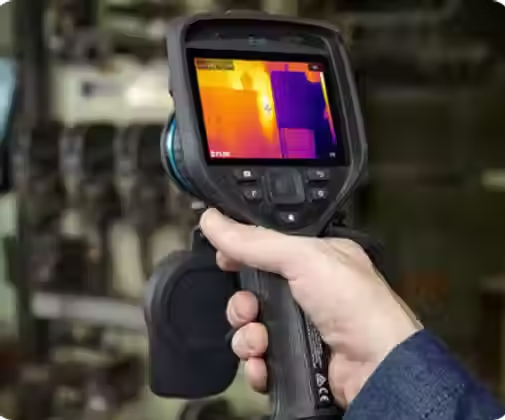
One of the most valuable tools within an Electrical Maintenance Program is infrared thermography.
Electrical infrared inspections allow trained professionals to examine energized equipment for abnormal thermal patterns that may indicate problems such as loose connections, overloaded circuits, load imbalances, or deteriorating components.
The major advantage is that thermal inspections can be performed while applicable electrical systems are energized and operating under load.
That gives facility teams insight into conditions that may otherwise remain hidden.
Regular thermal monitoring can help teams identify potential problems earlier, prioritize repairs, document equipment condition, and make more informed maintenance decisions.
And infrared technology isn't limited to electrical systems. Depending on the application, infrared imaging can also help facilities teams investigate HVAC performance, hidden moisture or roof leaks, and sources of unnecessary energy consumption.
How Electrical Maintenance Can Support Property Value
Preventive electrical maintenance is sometimes viewed exclusively as an expense.
For commercial real estate owners, however, it can be more useful to view maintenance through the lens of risk management and asset performance.
Lower Long-Term Operating Costs
Finding and correcting smaller electrical issues before they become emergencies can reduce costly reactive maintenance and after-hours service.
Reducing avoidable operating expenses can contribute to stronger net operating income (NOI) and overall asset performance.
Better Capital Planning
Condition data gives property managers and engineers greater visibility into their electrical assets.
Instead of replacing equipment based solely on age—or waiting until failure—teams can use inspection and maintenance information to make more informed CapEx planning decisions.
Extending equipment replacement cycles where appropriate can also help owners allocate capital more strategically.
Fewer Unplanned Disruptions
Electrical failures can be particularly disruptive in commercial buildings because a single issue can affect numerous tenants and building systems simultaneously.
Proactive maintenance helps teams identify potential failures before they turn into emergency shutdowns.
Better Maintenance Documentation
A formal EMP creates documentation showing what equipment has been inspected, what testing has been completed, what conditions were identified, and what maintenance actions were taken.
That record can become valuable for facility management, budgeting, compliance efforts, and insurance-related documentation.
What Should a Commercial Electrical Maintenance Program Include?
There is no single maintenance schedule appropriate for every commercial property.
A program should account for the facility's equipment, operating environment, system criticality, condition, and risk profile.
Assured NDT's Electrical Maintenance Checklist identifies several areas commercial facilities may need to address, including: Infrared thermography of main distribution equipment and switchgear. Thermal scans can identify abnormal hot spots and load imbalances while equipment is energized.
Ultrasonic acoustic inspections. High- and medium-voltage equipment can be evaluated for indications associated with discharge, arcing, and tracking.
Automatic transfer switch and generator testing. Emergency systems should be evaluated to confirm proper transfer and operation.
Ground resistance testing. Building grounding systems should be periodically evaluated.
De-energized switchboard and breaker maintenance. This can include torquing bolted connections, cleaning bus bars, and servicing breakers.
Transformer servicing. Maintenance requirements vary by transformer type and may include cleaning as well as oil testing for applicable liquid-filled equipment.
Generator load-bank testing. Emergency generation equipment requires testing under appropriate load conditions to validate performance.
Arc flash labeling and documentation audits. Single-line drawings, field conditions, equipment labels, and related documentation should be reviewed and maintained.
The checklist on page 4 of Assured NDT's white paper provides a useful framework for organizing these activities into an annual electrical maintenance plan.
Arc Flash Studies and NFPA 70E
An effective electrical safety strategy extends beyond preventive maintenance.
An arc flash study evaluates electrical systems to establish information such as appropriate approach boundaries, required personal protective equipment, and equipment labeling requirements.
For commercial property teams, keeping arc flash information and electrical documentation current is particularly important when electrical systems are modified, equipment is replaced, or building configurations change.
Electrical maintenance, NFPA 70B, and electrical safety practices associated with NFPA 70E therefore work together as components of a broader electrical risk-management strategy.
Moving From Reactive to Condition-Based Electrical Maintenance
A reactive maintenance strategy is simple: repair equipment when something goes wrong.
Unfortunately, electrical failures rarely choose convenient times to occur.
A condition-based approach gives property managers and facility engineers more information about what is happening inside their electrical systems before a failure occurs.
That can mean fewer late-night emergency calls, better justification for maintenance budgets, longer equipment replacement cycles, and safer conditions for employees and tenants. Most importantly, it moves maintenance decisions away from guesswork.
Building an Electrical Maintenance Program With Assured NDT
Every commercial property is different. Equipment age, electrical loads, tenant requirements, maintenance windows, budgets, and system criticality can vary significantly from one facility to another.
Assured NDT works alongside property managers, facility engineers, and maintenance teams to develop Electrical Maintenance Programs tailored to those conditions.
Our capabilities include Electrical Maintenance Program development, infrared thermography, and arc flash studies, helping commercial real estate teams establish a more proactive approach to electrical reliability and compliance.
If your property is evaluating its current electrical maintenance practices or preparing to establish a formal EMP, now is the time to understand the condition of your electrical infrastructure and develop a documented plan.
Contact Assured NDT at 561-660-2751 or visit AssuredNDT to discuss an Electrical Maintenance Program for your commercial property.